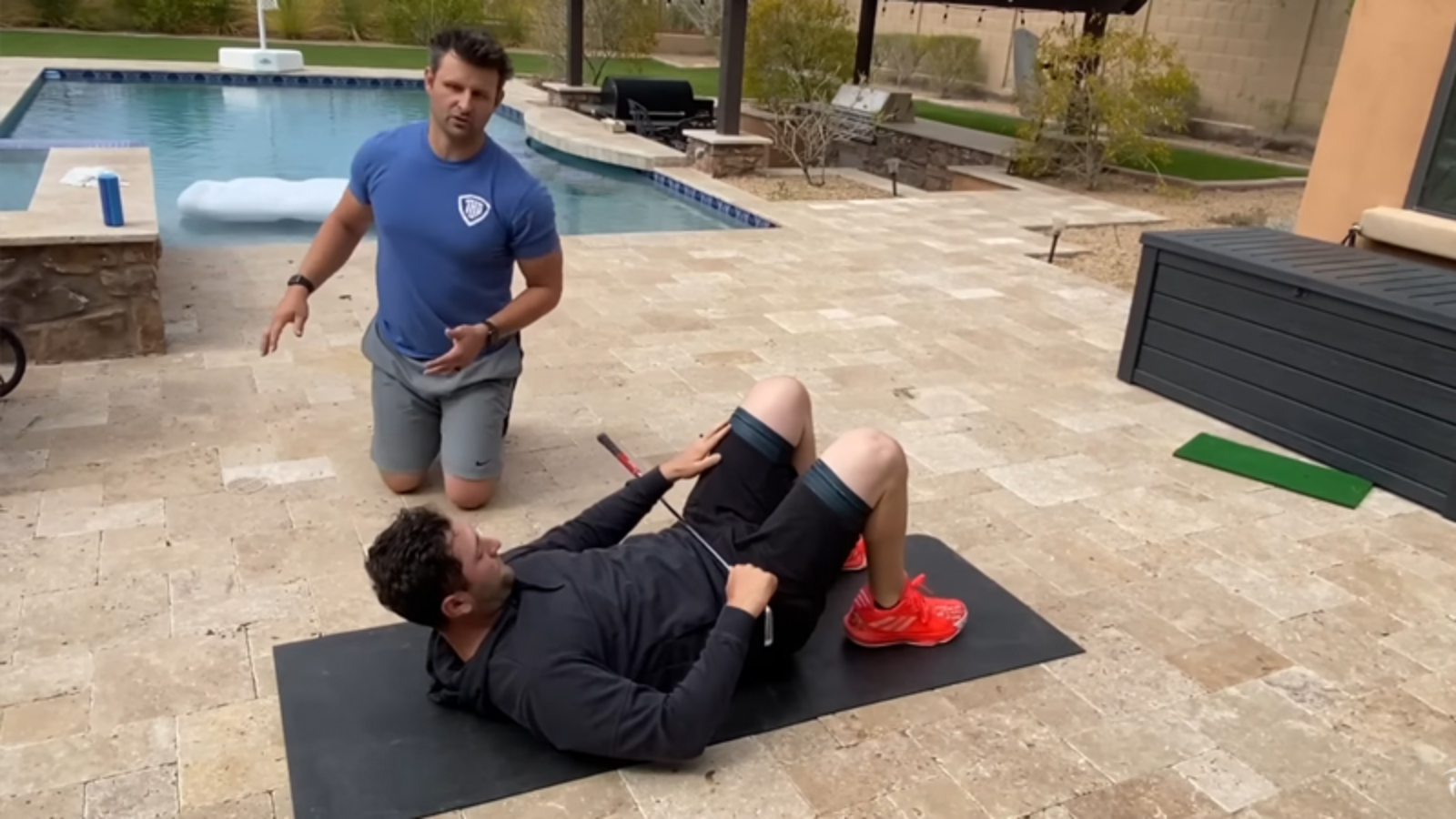
Hello everyone, I'm Jon Rahm, and this is my trainer Spencer Tatum. We're going to go through one of my favorite warm-ups that I do before every round. I do it almost every day, and it basically consists of warming up your core and glutes — the king and queen muscles in the golf swing.

On those days when we're all sitting at home a lot, these are the first two muscles that are going to go, so getting your core and abs activated is going to be very important. Spencer is going to guide me through it and explain what we're doing, and I'm going to give you my personal input on what I feel. The one thing you will need is an iron — try to get a long iron. I have a five iron here, and you're going to be using it throughout the whole exercise.

This warm-up helps not only with John's mobility and stability, but also prepares him to play. It can also be used as a strength warm-up on the road. So if you're at home sitting around a lot, you've likely got really tight hip flexors — especially if you've been playing Xbox — and this is going to help get everything back aligned before you get back to swinging your golf club or getting into training sessions
We're starting with John lying down on his back.

As you can see, he has his five iron, and what he's really trying to feel is that pelvic tilt — pushing into the ground. He's going to take the club, apply a little bit of pressure to engage his core, and hold it. He's going to breathe in and push down the whole time, holding that midline as he comes back up. We're building stability in the core while also working mobility in the hips.

John is going to demonstrate about three reps here. As you can see, he's really focused on keeping pressure in both the upper and lower body while maintaining that stability. After that, he's going to move to a bridge — a core activation bridge, still using the five iron. The same concepts apply. He's going to hold that midline, create pressure, and focus on breathing as he extends that hip.

A lot of people are going to want to arch the lower back — make sure you're really holding it and driving into the ground as you extend that hip. John is going to do three reps. Notice the pressure and the breathing — breathing out at the top, breathing in on the way down. This is really working single-leg strength in the lower body, hip mobility, and core stability up top.

Now we're going to start working on some thoracic spine mobility. John is going to start here and move right to left, with his feet going in the opposite direction of the club. He's really focused on that separation — how far can he go each way — while making sure his back doesn't arch, keeping his knees in line with his hips, and breathing out on the movement and in on the transition.

We really like this for creating separation in the golf swing and mobilizing the thoracic spine to get ready to play. This might actually be my favorite exercise. It's very important to focus on the timing — try to have your legs reach their limit at the same time as your upper body and club. If you're out of sequence, you won't be getting the full benefit of what we're trying to accomplish. It also helps with timing and sequencing in your golf swing.

Next is the hollow body position. This one I don't personally love, but it really helps lock in the midline. The key thing we don't want is a reverse spine angle or early extension. John is really focused on creating pressure with his top hand and lat, pushing down and compressing, breathing in and trying to stay as long as possible without losing that midline.

As he breathes in and out, he should feel tension throughout, and he shouldn't be losing that position. Notice the amount of pressure he's applying — it's a lot. Working that compression force is very important. If you lose it, the arm gets loose and you may arch your back. If you keep this pressure going continuously throughout the whole exercise, it's very hard to arch, especially when you're using that hip and pushing into the hand. We'll do the other side to stay balanced three to five reps — and what you're really trying to do is feel that connection from the opposite shoulder to the opposite hip.

Now we're going to move on to straight-leg sit-ups. Really focus on rolling down vertebra by vertebra, and coming back up the same way. Try to keep your arms above your head at all times. I'm pulsing a little bit the stronger you are, the easier it will be. Try to keep your arms straight without using them to get up. This is a great way to build that connection, warm up the body, and prepare for hip hinging, which is important for your setup. We usually do somewhere between 8 and 10 reps, or however many it takes until you feel warmed up.

Now we're going to start working up the chain. Notice how we started on the back — just like how we learn to move, we're warming up in that same progression. Now we move into a half-kneeling position. On this exercise, you start by relaxing back into your hip, put a little pressure down on the club, and then drive through and extend that hip to create balance on the midline. If you do it properly, you should feel a stretch in the hip while pressing down on the club, and you'll feel that connection from your shoulder all the way down to your knee. Hold it for about two seconds, and do about five reps on each side.

Notice how we're working on what we call the rack and stack John is racking it up and stacking straight up. We don't want to see him leaning back and losing that position. All the previous warm-up work is going to help here. If your core is activated and working properly, you won't lose your back position — your abs will keep you feeling like a straight plank. Do three more reps here, pushing down first and then driving that hip through to get that nice stacked feeling. It's actually very similar to a dead bug if you do it one-handed, you'll feel that same compression and connection.

Now we've worked through the transition period and we're moving to standing — specifically single-leg RDLs. This is not my favorite exercise. It's hard to maintain balance throughout, and I struggle with it if I haven't warmed up properly or haven't trained in a while. Try to keep your arm extended, maintain pressure between your leg and your arm, and perform a normal RDL. Try to reach parallel if you can, but never lose that pressure between your arm and your leg.

Notice how he's really working through the feet — gripping the toes into the ground to anchor the foot down. This helps prevent sway and slide in the golf swing. We're also working on loading the right and left hip, getting into that position so we can drive through the ball.

Not everyone works out every day, and not everyone has the stability for this right away — just work on it. If you fall a couple of times, don't worry about it. Focus on how your body is warming up, and don't stress too much about the RDLs if they're too technical. Just work your way up to it.

Now all the joints are involved, so we're working at a higher level. The last thing we're going to work on is a two-legged hip hinge to get ready to swing the golf club. For those who know, it's almost like presetting for a deadlift — but try to keep your elbows open, not closed, and keep the club touching your body as much as possible as you hinge.

What we're looking for is whether John can keep his head, shoulder blades, and glutes all connected to the club while putting force into the ground and loading the hips. Notice how his shin angle stays nice and vertical — he's not falling back and losing power, and he's not squatting too deep either. This is a challenging pattern. It looks simple, but it's much harder than it appears.

Try switching hands as well. As soon as you feel the club leaving your body — if you start bending the upper body without hinging — you'll see the club is no longer touching your spine. That means you've gone too far, so bring it back. Now John, how important is breathing during this? It's important for keeping your tempo. You're not going to hit the ball while inhaling, so you need to work on that.

Essentially, you inhale and hold your breath during the challenging part, and when you need to explode, that's when you exhale. So to put it simply — breathe in for stability, hold your breath during transitional periods, and breathe out when you're generating mobility and power. Breathe in, hold, and exhale hard at the top.

It's a very simple warm-up — all you need is a five iron and a mat if you're on a hard surface. This should get you ready to go. It's something everybody can do, especially now that so many of us are sitting down a lot. At the very least, it'll help prevent back pain and get your muscles working properly.

If you find one area that needs more attention, remember three to five reps on each side or each movement. If after three to five reps you don't feel like you've got it, do two or three more until you do. If it feels easy, do three and move on. It's more about the feeling and quality of movement than the volume. You can do this one to three times a day and you'll see a major improvement in your mobility and stability, which will hopefully translate into a better golf swing.

Stay positive, stay home, wash your hands, and let's hope we can get through this with a positive attitude — and improve your golf game while we're at it. This is Jon Rahm and Spencer Tatum. We'll see you soon.